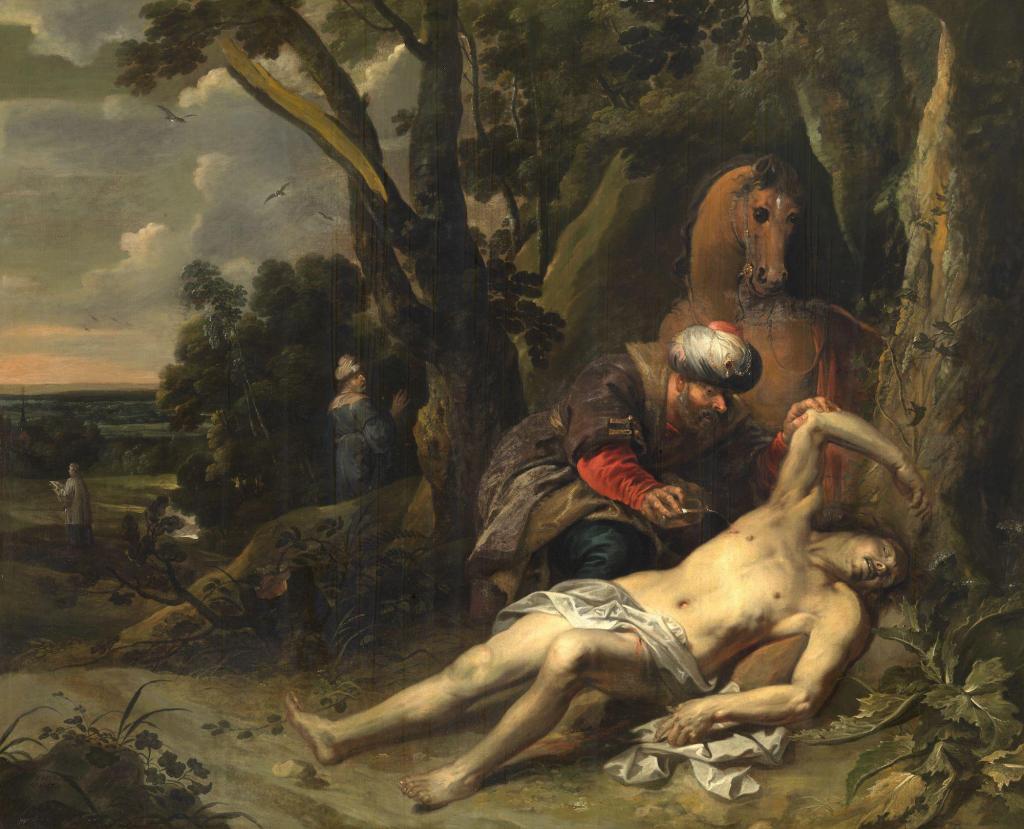
(Image courtesy of Wikipedia)
Whilst searching through the British Newspaper Archive recently, I came across a tragic story about a child in need far from home, and how different characters responded to his plight. It reminded me of the parable of the Good Samaritan. This account of the events that took place is based on the report contained in the Devizes and Wiltshire Gazette dated 4 February 1847.
One winter’s day in January 1847, the Reverend James Stoughton Money Kyrle, the rector of Yatesbury, Wiltshire, was driving his gig to Chippenham, Wiltshire. As he reached Quemerford Gate, on the outskirts of Calne, his attention was caught by a boy, dressed like a sailor, walking by the roadside, who appeared to be in a lot of pain from the soreness of his feet. Although the boy was not begging “he looked at me so imploringly that I pulled up and spoke to him”.
The boy told the gentleman that his name was George Beale. He was fourteen years old and was travelling from Devon to London. His parents lived at Chichester Place, Grays Inn, but his father had arranged for him to go to sea after the family had fallen on hard times. Five months ago he was abandoned by the crew of the ship in Exmouth, so he had set out for London on a journey of over 170 miles. In the depths of winter and with inadequate footwear, his feet were becoming a mass of chilblains and blisters.
After hearing his sad story, Reverend Kyrle gave George a shilling and told him to make “the best of his way home”. At this the boy burst into tears and said that the Reverend was the “best friend he had ever met”. Moved by the boy’s plight and suffering, Reverend Kyle decided to give George a note, addressed to his housekeeper, instructing her to look after George until his return from London. He was going to check out George’s story and if he could substantiate it, he would help George get a job or provide for him in some other way.
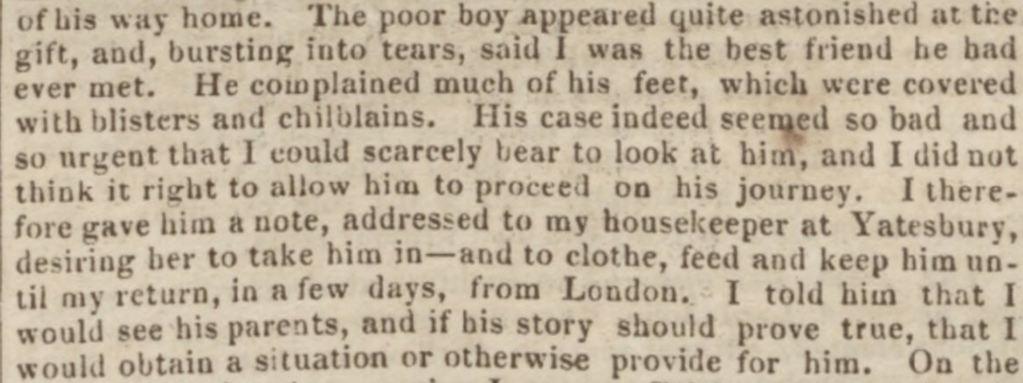
(courtesy of British Newspaper Archive)
The Reverend was as good as his word and the following Wednesday, visited the boy’s father at Chichester Place, Grays Inn. He found that the boy’s father, Samuel Beale, had indeed fallen on hard times and was in a state of extreme destitution. He was lodging on the third floor of the building, over a carpenter’s shop. Formerly, he had been not only the owner of the house, but had built a large portion of the street in which it stood. In regard to his son, the father said that George was “naturally of a very good disposition, but that he had sent him away to sea to keep him from the contamination of bad company”.
Taking a look at the 1841 census, the Beale family were indeed living at Chichester Place, Grays Inn:
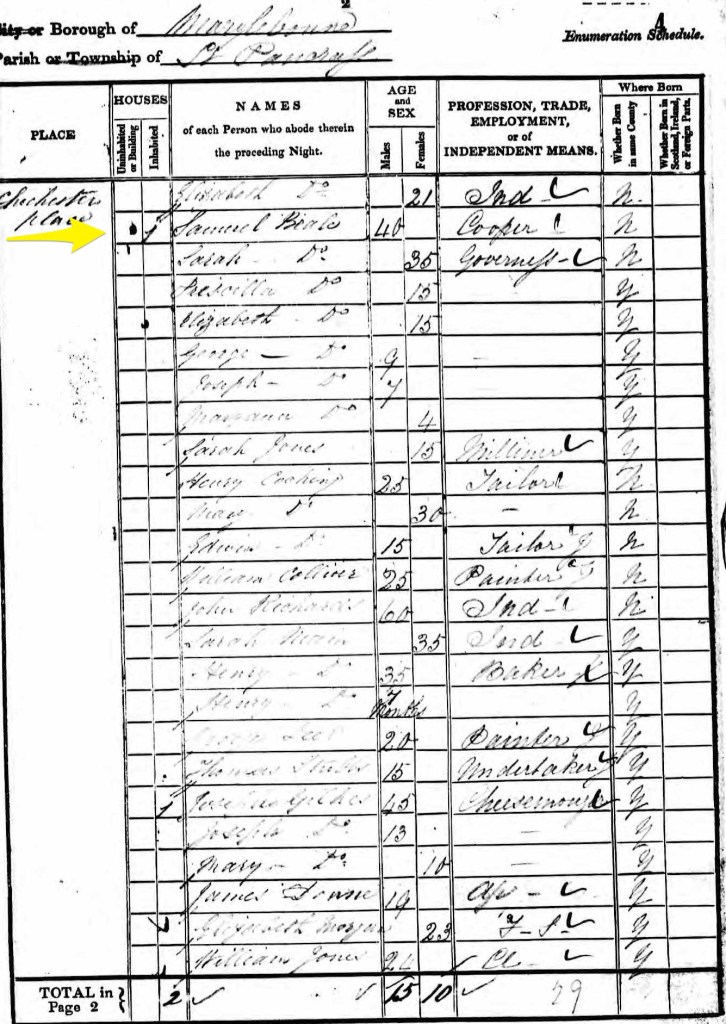
via https://www.ancestry.com
HO 107 682 11 4
The National Archives of the UK
Samuel Beale, George’s father, was a cooper by trade and he appears in several London trade directories around this time. George’s mother, Sarah, was a governess, and the couple had five children, Priscilla and Elizabeth, both aged 15, George aged 9, Joseph aged 7 and Maryann aged 4.
In the criminal registers for the county of Middlesex, a George Beale is listed aged 13 at the county sessions at Clerkenwell on November 4th 1845. He was convicted of two accounts of larceny and was sentenced to a month of imprisonment as well as a whipping for each conviction. Perhaps this was the event that had precipitated Samuel Beale to remove his son from home and “bad company”.
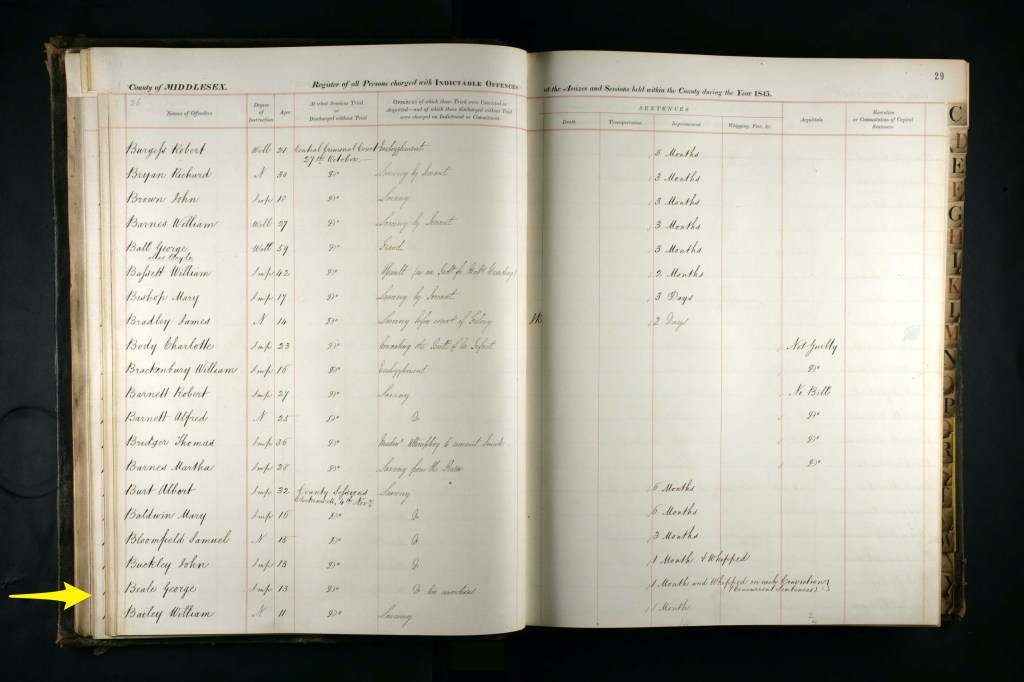
Ancestry.com England and Wales Criminal Registers 1791-1892
Reverend Kyrle told Samuel Beale that he wanted to help his son and the father expressed much gratitude. With his mission accomplished, the Reverend returned home on Saturday to meet with George, no doubt with some plans to set him up in a trade and find him employment. However, when he arrived, he received awful news: the boy had been found dead.
According to witnesses, George had continued on the road towards Yatesbury, as far as Cherhill, but then paused to ask directions to the Rectory. The first stranger he had stopped couldn’t tell him, and the next was illiterate and could not read the note. He was eventually put on the right road but never arrived at his destination. Instead he was found wandering about in great distress by a carrier who brought him back to Quemerford Gate, Calne at two o’clock in the morning on Tuesday. Here he was kindly taken in, fed and permitted to sleep by the keeper of the gate, a man named Clifford. At nine in the morning, Clifford consigned him to the care of Angel Bullock, the Yatesbury postman, with strict orders that George was not to leave him until he had reached the Rectory. At the same time, and for better security, he took the Reverend’s note and gave it to Angel Bullock for safe keeping.
Angel Bullock was obviously none too pleased to have this boy in his charge, who, due to the pain in his feet, could only walk slowly. After walking with him only 200 yards, he told the boy that he would have to leave him behind, despite the boy crying bitterly, begging and praying Bullock not to desert him. Nonetheless, this is what Bullock did, taking Reverend Kyrle’s note with him.
The boy continued as far as Cherhill, where he had been the day before, but he was either too frightened to go to the Rectory at Yatesbury or still did not know the way. He spent the night in an outhouse belonging to a man named Church and the next morning, he was standing near the house of Mr Pottow, who kindly gave him some breakfast. The story then takes a darker turn, as reported here:
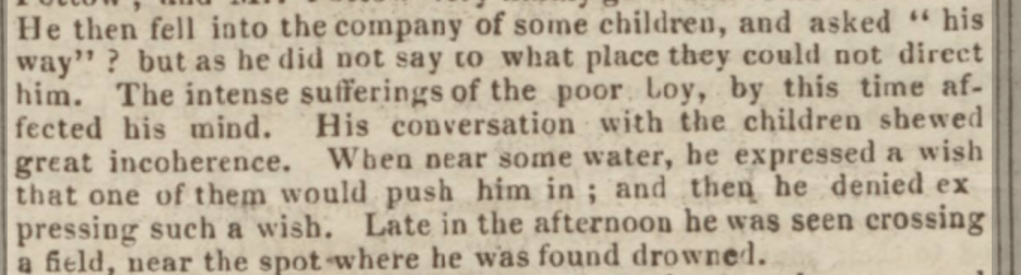
(courtesy of British Newspaper Archive)
George had been at his lowest point, both mentally and physically, and had taken his own life. A coroner’s inquest was held into this death and the coroner complimented the “very humane and benevolent conduct of Mr Kyrle towards the unfortunate boy”. With one final act of kindness, the Reverend paid for and conducted George’s funeral, interring his body in the churchyard at Yatesbury:

Wiltshire & Swindon Family History Centre, Chippenham, Wiltshire
via http://www.ancestry.com
The newspaper article ended by saying the the Reverend Kyrle intended to erect a tablet to George’s memory.
This story gave me much to consider. Firstly, George’s father, Samuel Beale, was obviously, at one time, fairly prosperous, earning a solid living as a cooper, building houses and supporting his family well. How had he been reduced to penury? His death certificate suggests the reason. Samuel Beale died on March 10 1847 aged fifty three, just a month after his son after suffering from phthisis (tuberculosis) for thirteen months. His ill health had undoubtedly caused the severe decline in the family fortunes:

General Register Office
By enlisting George in the Merchant Navy, probably in the knowledge that he had not long left to live, Samuel must have felt that he was giving his son a good opportunity for a brighter future.
The Reverend Kyrle, true to his vocation, acted as a Good Samaritan, offering help to George offers at his own expense. He was not the only character who comes out of the story well. The kindly keeper of Quemerford Gate, a man named Clifford, also tries to help George, arranging for him to be escorted safely to Yatesbury Rectory. Mr Church who lived at Cherhill, lets him sleep in an outhouse and Mr Pottow gives him breakfast. The one unsavoury character is Angel Bullock, the Yatesbury postman (and the uncle of my own three times great grandfather, Angel Bullock). What if he had shown some compassion towards George Beale that day and taken him to the sanctuary of the Rectory at Yatesbury? Would George’s life have been saved? Actions can have unforeseen consequences and an event that happened over 150 years ago holds a lesson for us all.
© Judith Batchelor 2020
In A Noble Legacy, I discover more about the Reverend Kyrle. In another act of kindness, he erects a memorial to George in the churchyard at Yatesbury. He also saves George’s mother who nearly perishes in a snowstorm when visiting Yatesbury.

 Genealogy Jude
A very good but sad story.
FMP have lots of burial transcriptions, with extra details noted ,listed for Wiltshire burials but none for this boy. Just the transcribed burial record as you show above. However it could be there in the church, just not noted?
LikeLike
Looks like his baptism was 6 Nov 1831 at Camden St Pancras, Old St Pancras. George Beale son to Samuel and Sarah Beale, his father’s occupation is given as Cooper and they are from Chichester Place.
LikeLike
Thank you! It’s been nice to find that information in the newspaper about George’s family in London can be corroborated.
LikeLike
I am in touch with the church at Yatesbury. They are going to see if there is a memorial to George. It would be lovely to find out if he is indeed commemorated.
LikeLike
Nice blog
LikeLiked by 1 person
Thank you!
LikeLiked by 1 person
Jude, did you see a follow-up to the story regarding his mother? In the middle of February, George’s mother came from London to visit George’s grave but she was caught in a snowstorm and almost died. She was taken to Yatesbury rectory, where she was “restored” and then returned to London 2 days later with her rail fare paid for by various principal farmers of the parish (Salisbury and Winchester Journal – Saturday 20 February 1847; Devizes and Wiltshire Gazette – Thursday 18 February 1847)
LikeLiked by 2 people
No, I didn’t know this, thank you! I think I might have to write a follow up now.
LikeLiked by 2 people
Such a sad story to read – a good Samaritan domino effect until he reached an Angel! I have Bullock Ancestors also, but from Gloucestershire. Well done.
LikeLiked by 1 person
Thank you, really lovely to have your feedback.
LikeLiked by 1 person