When tracing our ancestors back through the years, all can be going well until we hit the 1700s. Suddenly, sources seem to dry up and it’s easy to lose heart. Maybe you have found your ancestors’ names in a parish register, but know little about them as people: they remain faceless and anonymous. Perhaps you have struggled to even find them or are unable to determine who is who because you have more than one candidate. It can all get very demoralising. However, after some recent success researching my Sears ancestors who lived in 18th century Kent, I thought I would share what I have discovered and hopefully provide some inspiration.
In the 18th century, the Sears family lived in the small rural parish of Stockbury. Stockbury is situated on either side of a valley, with the main road (now the A249), between Maidstone and Sittingbourne, running through it. However, much of the parish extends above to the hills of the North Downs.
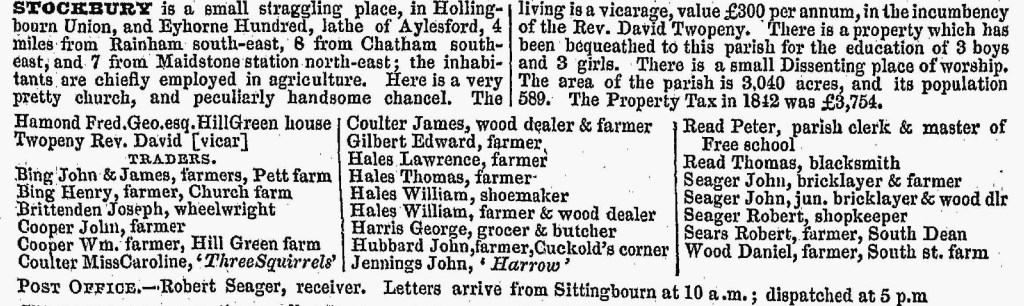
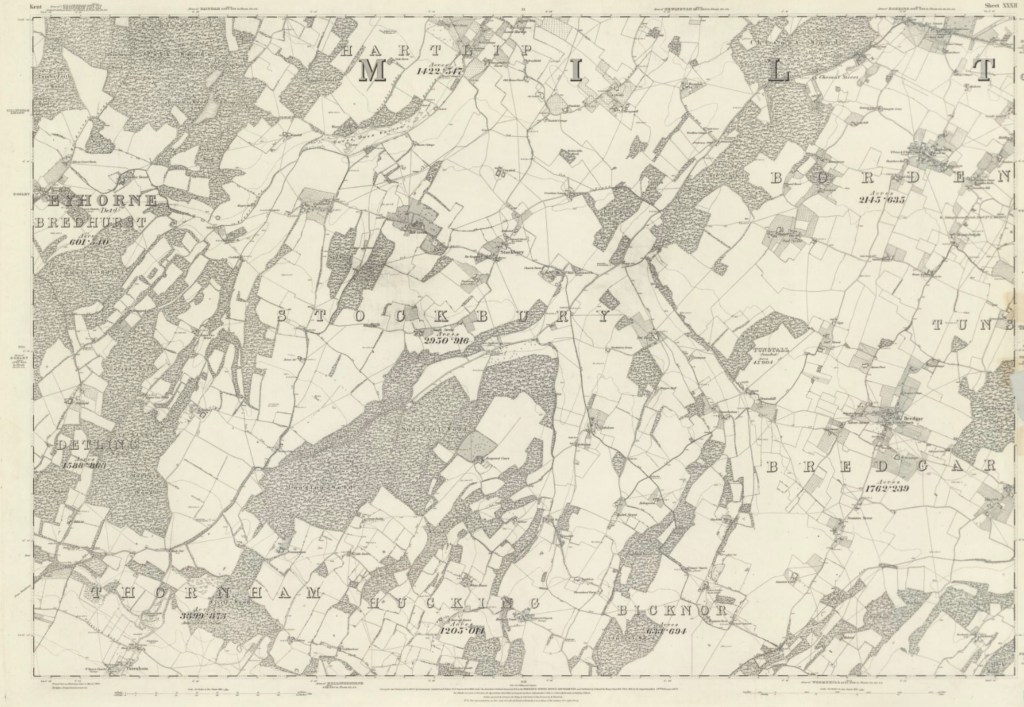
Reproduced with the permission of the National Library of Scotland
https://maps.nls.uk/
My 4th great grandfather, Christopher Sears, married Elizabeth Kerby on 3 April 1781 in the parish of Hucking, and they had six children baptised in neighbouring Stockbury between 1781 and 1796. In his old age, after being widowed, Christopher had gone to live in Boxley, just outside Maidstone, with his youngest daughter, Elizabeth, and her family. He lived to a ripe old age, as he is recorded in the 1841 census and died aged 90, in 1845. On his death certificate he is described as a labourer.
My research into the Sears family was triggered by a find in a newspaper. When your ancestors are ordinary folk, it may seem unlikely that you are going to find any mention of them in a newspaper prior to 1800. However, whilst browsing the newspaper collection on FindmyPast, I found a small gem that piqued my interest. I was pleasantly surprised to find a reference to Christopher Sears in an advertisement in the Kentish Gazette in 1798:

Image © THE BRITISH LIBRARY BOARD. ALL RIGHTS RESERVED.
A sale of freehold estates, situated in various parishes in Kent, was taking place in London on 24th January 1798. They were to be sold in one lot and consisted of seven farms. Each were listed with the annual rent per annum. Bowes Ear Farm, in the parish of Stockbury, three miles from the high road, and containing 62½ acres, had been let to Christopher Sears on a lease for nine years from 1796, as well as “thirty-five acres of Wood Land in hand”. The rent was £19 and 10 shillings per annum for the farm, not including the woodland. The advertisement claimed that all the farm rents were low but could be increased considerably when the leases expired. Until now, I had thought that Christopher Sears had only been an labourer, but now I knew that he had leased a farm in his younger years.
At first, I couldn’t trace any reference to Bowes Ear Farm, as rather understandably, it had been spelt phonetically. The 1870 Ordnance Survey map of Stockbury revealed Beaux Aires Farm, situated in the south-west of the parish (underlined in red on the map):
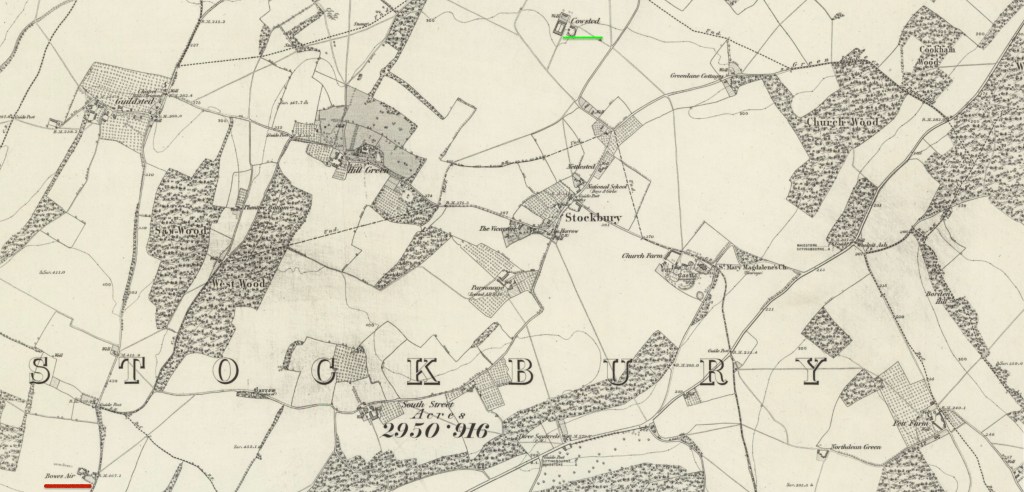
Reproduced with the permission of the National Library of Scotland
https://maps.nls.uk/
Beaux Aires farmhouse is listed and I found further details, including a photograph, on the Historic England website: https://historicengland.org.uk/listing/the-list/list-entry/1186213
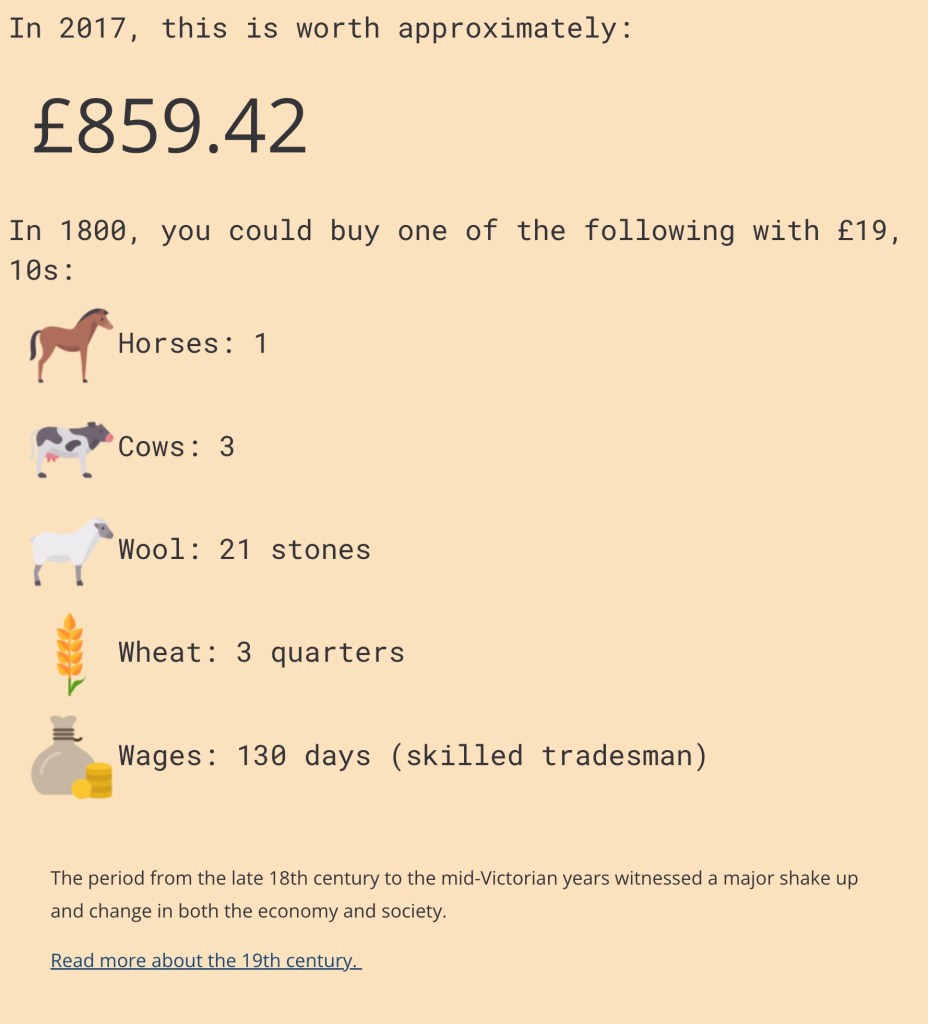
The farmhouse appears substantial and according to Historic England, the facade dates from the 18th century, though the house itself may be older. Maria, my 3rd great grandmother, who was baptised in 1790, would have been around six years old when Christopher had taken out the lease at Michaelmas 1796, so she must have grown up in the house. The Currency Convertor on the website of the National Archives gave me an indication of what Christopher Sears’ annual rent of £19 10 shillings could buy in 1800:
Since he leased his farm, I found a Christopher Sears recorded as an occupier in Stockbury in the Land Tax Redemption records in 1798:
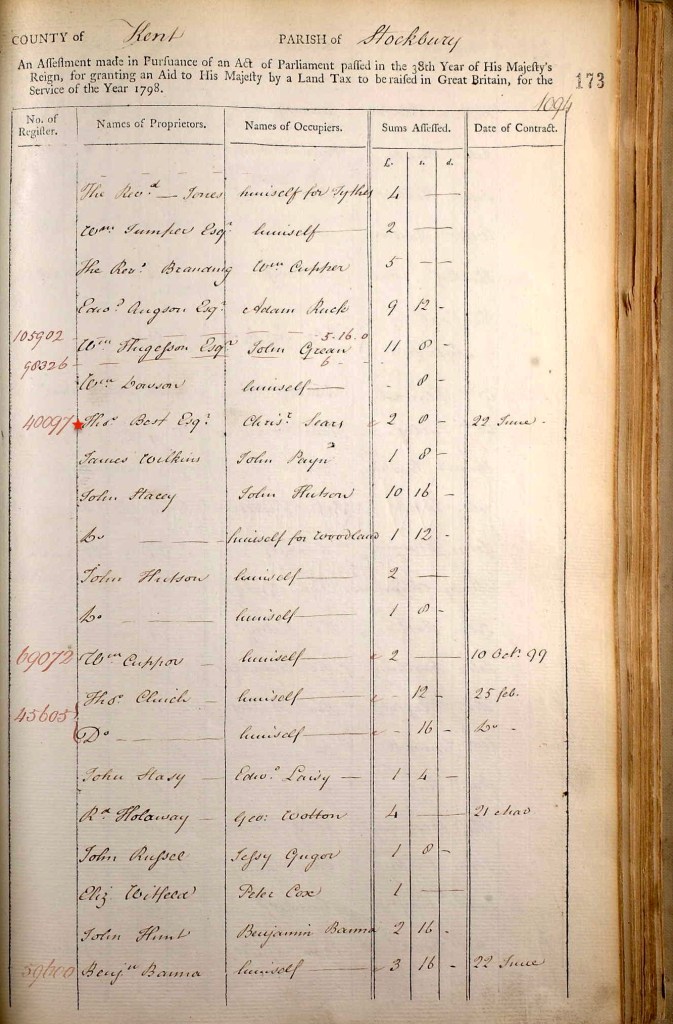
Land Tax had first been introduced in 1692 and in 1776, it was set at four shillings in the pound. In 1798, the Land Tax Redemption Office was created and land tax became a perpetual charge but it could be redeemed by landowners paying a lump sum. From the tax records, I now knew that the proprietor of Beaux Aires Farm was Thomas Best Esquire and he was assessed to pay £2. You can gage the relative size and value of the farm from the amount of the assessment. Although names of farms are not recorded in the tax records, the information on ownership can be used to identify a property in manorial and estate records.
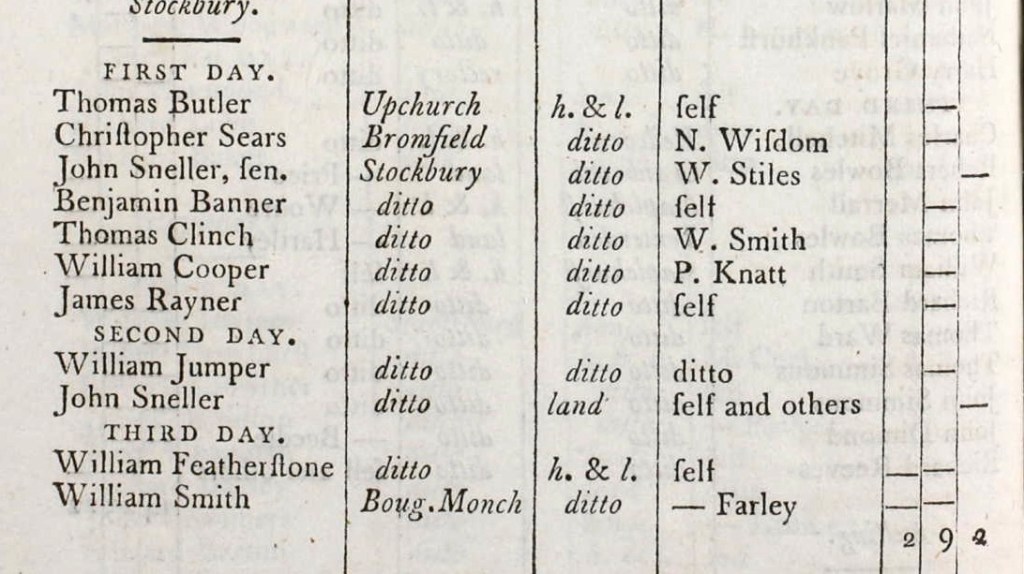
I found a further reference to Christopher Sears in a Kent Poll Book of 1790. Poll books were designed to stop fraud and contested results and were published until the secret ballot was introduced in 1872. The sheriff of the county had to make a list of voters, their qualification, and the candidate whom they voted for in the election. Prior to the Great Reform Act of 1832, it’s been estimated that only about 1% of the population (400,000) could vote, as the entitlement to vote was given only to those who owned land that had an annual value of 40 shillings. Clearly, Christopher Sears qualified:
UK, Poll Books and Electoral Registers, 1538-1893 via http://ancestry.co.uk
There were three days of voting for knights of the shire at Pennenden Heath, Maidstone, on June 28th, 29th and 30th 1790. Christopher Sears cast his vote on the first day, giving it to the candidate, Knatchbull. Although he resided in Stockbury, (where he leased his farm), his qualifying freehold land was in Bromfield, (Broomfield today, close to Leeds Castle), where it was in the occupation of N. Wisdom.
I found another reference to Christopher Sears (spelt Sayers) in the Kent Poll Book of 1802:

UK, Poll Books and Electoral Registers, 1538-1893 via http://www.ancestry.co.uk
In this record, there is no information on the property qualification and Christopher Sears decided to vote for the candidate Geary, rather than Knatchbull, whom he had voted for twelve years previously. Cleveland Seeres, also listed in Stockbury, was his cousin.
I was surprised not to find Christopher Sears listed as a proprietor in Bromfield in the 1798 Land Tax Redemption, since his land in Bromfield had given him the qualification to vote. I discovered that his name had not been indexed, as I found him listed when I searched under the name of his tenant. The assessment of Bromfield recorded that Christopher Sears was a proprietor, along with Richard Day, of land occupied by John Wisdom. N. Wisdom, who was recorded as the occupier in the 1790 Poll Book, was probably his father. The amount of the assessment was twelve shillings:

The National Archives; Kew, Richmond; Surrey, Land Tax Redemption Office: Quotas and Assessments, IR23; Piece: 38 via http://ancestry.co.uk
Returning to parish registers, I found that the baptism of Christopher Sears had taken place in Thurnham, just south of Stockbury, on 24 September 1758. He was the son of Christopher and Sarah Sears, though the spelling had been corrected to Sares:
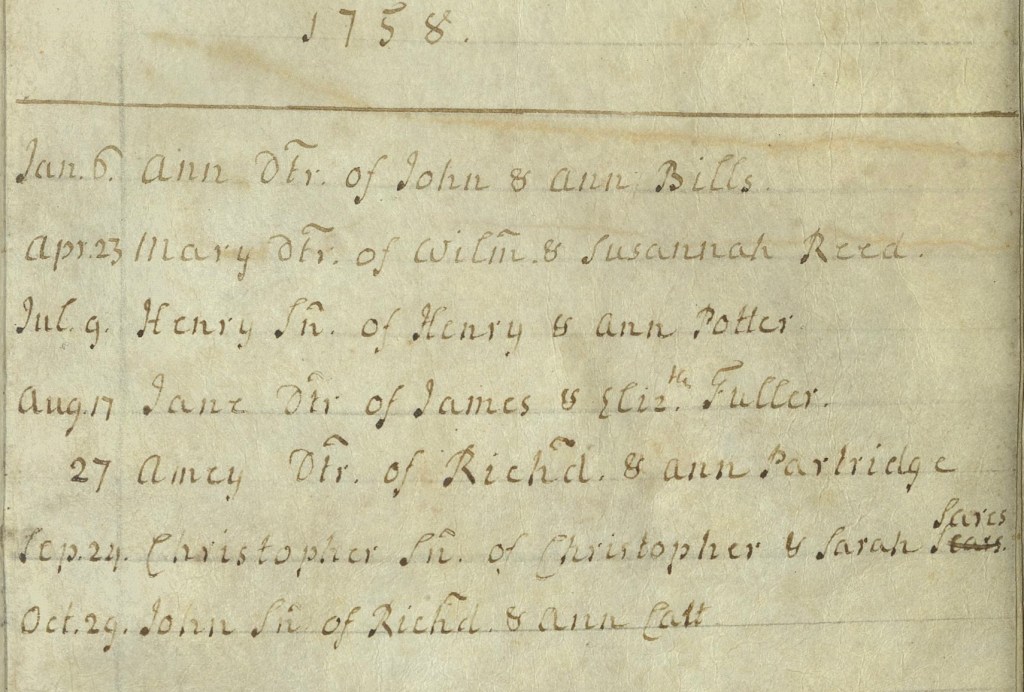
The baptisms of two other children, Sarah, who was baptised on 25 September 1760, and Elizabeth, who was baptised on October 3 1762, (both recorded under the variant of Sares), were also found in the Thurnham registers. Elizabeth did not survive infancy and her burial is recorded in Hucking on 31 October 1766.
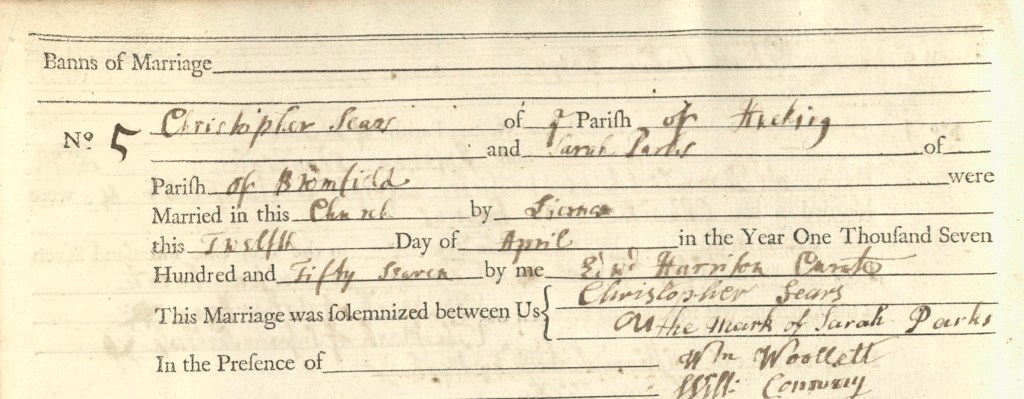
Christopher Sears senior married Sarah Parks on 12 April 1757 in Bromfield.
Broomfield St Margaret Register of Marriages 1754-1806 via http://findmypast.co.uk
Christopher Sears was from Hucking but Sarah Parks was of Bromfield, so perhaps the land in Bromfield that had given their son the entitlement to vote, had been passed down to him through his mother’s family.
Christopher Sears senior was baptised in Stockbury on 6 November 1726, the son of another Christopher Sears and his wife, Elizabeth, making three generations of Sears ancestors named Christopher:
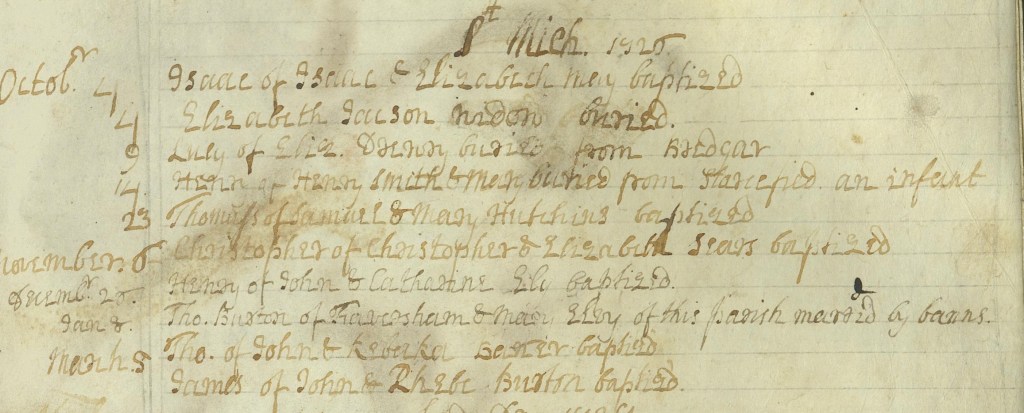
Stockbury St Mary Magdalene Composite Register 1675-1812 via http://findmypast.co.uk
Christopher Sears senior had married Elizabeth Cleveland in Stockbury on 11 October 1720:

Stockbury St Mary Magdalene Composite Register 1675-1812 via http://findmypast.co.uk
Since the Sears family obviously owned and leased land, there was the possibility that they had made wills, which could provide more information on them. The Kent Probate Index is available online on the website of the Kent Archives and Local History Centre: https://www.kentarchives.org.uk/wills-probate-records/. I found three wills of particular interest:
| Christopher Sears of Hucking, 1763 | PRC 32/64/540 PRC 31/233 S/3 |
| Robert Sears of Hucking, 1765 | PRC/32/65/104 PRC 31/235 S/3 |
| Christopher Sears of Hucking 1768 | PRC 32/65/291 PRC 31/238 S/4 |
Unfortunately, the actual probate records are not viewable online so I visited Kent Archives in Maidstone to view them on microfilm and obtain photocopies. I then made abstracts for each:
Will of Christopher Sears, yeoman of Hucking dated 27 October 1759, proved 17 May 1768.
His son, Christopher Sears is to receive his messuages, lands, tenements, hereditaments, and real estate.
His daughter, Ann, the wife of Isaac Doe, is to receive £20
His daughter, Mary, the wife of Thomas Hoath, is to receive £10
His granddaughter, Ann, the daughter of Ann Doe, is to receive £10 if she reaches the age of 21
His granddaughter, Elizabeth, the daughter of Mary Hoath, is to receive £10 if she reaches the age of 21
His son Christopher is to receive £150 to be secured by Bond to Ann Allen, his intended wife, in case their marriage takes effect and she survives him.
Christopher Sears appointed as sole executor.
Testator makes his mark.
Witnesses: Edwin Turner, Henry Waterman, Sam. Eastchurch.
This was clearly the will of Christopher Sears senior, who had been widowed when he made his will. As well as his son, Christopher, I now knew that he had two daughters, Ann and Mary. Although I couldn’t trace the baptism of Ann, I found the baptism of Mary on 5 November 1721 in Stockbury. Mary had married Thomas Hoath on 8 February 1752 in Chatham and her sister Ann, had married Isaac Doe a few months later on 7 June 1752 in Maidstone. Thomas and Mary Hoath’s daughter, Elizabeth, was baptised on 29 March 1754 in Boxley, whilst Isaac and Mary Hoath’s daughter, Ann, was baptised on 10 February 1753 in Bicknor. Of particular interest was the reference to Ann Allen, the “intended wife” of Christopher Sears. Christopher Sears had made his will on 27 October 1759 and I found an indexed reference to his marriage to Ann Allen a few months later on 10 January 1760 in the Hucking parish registers. In his will, Christopher Sears stipulated that if his marriage took place and Ann survived him, she was to receive £150 that was to be given to her by his son, Christopher Sears junior.
I also found another reference to the marriage of Chris Sears and Ann Allen dated 28 October 1759, in Ancestry’s collection, “Kent, England, Extracted Parish Records 1539-1876”, taken from Canterbury Marriage Licences 1751-1780. It appears that Christopher Sears had settled his affairs and applied for a marriage licence the day after he had made his will. The father of Ann Allen is named as Nathaniel, which suggests that Ann was a minor and much younger than her husband. It would be worth obtaining a copy of the record.
Christopher Sears junior only lived a few more years after his father, as he died in 1765. His will was filmed badly and too faint to read so I had the privilege of reading a copy of his original will, recorded in the book of registered wills proved in the Archdeaconry of Rochester. I made the following abstract:
Will of Christopher Sears, Farmer of Hucking, dated 13 April 1768, proved 5 May 1768
Estate divided between his “two dearly well-beloved children, Christopher and Sarah Sears”.
House, land and tenements etc. in Detling, now in the occupation of Richard Naylor or his under tenants.
House, land and tenements etc. in Stockbury, now in the occupation of Widow Grisby or her under tenants.
Household goods, horses, cows, sheep, cattle, chattels, ready money, securities for money, corn, hay, husbandry, tackle, given to his two children to be equally divided amongst them when they reach the age of 21.
Profits from the lease of his farm bequeathed to his two children.
Children are appointed as joint executor and executrix under the guardianship of his “trusty brother” Isaac Doe, living in the parish of Wormshill and his cousin, Cleveland Sears, of the parish of Hucking.
They are to use their endeavours for the good of the children and are to receive £5 each.
Witnesses J.T. Leyland, John Gilberd his mark and Sarah Gilberd.
Sadly, Christopher Sears knew that his death was imminent and wrote his will to secure the future of his two children who were already motherless. His burial is recorded in Hucking less than two weeks later on 26 April 1765. Although they were only aged nine and seven, he appointed his children as executor and executrix under the care of his “trusty brother”, Isaac Doe of Wormshill, (in fact, his brother in law), and his cousin, Cleveland Sears, who also lived in Hucking.
I believe that it’s significant that the will of Christopher Sears senior was proved twelve days after the will of his son, despite the fact that he had died in 1763, five years previously. I would speculate that his will only surfaced after the death of his son because the latter did not want to give £150 to his father’s young wife, Ann, (Allen), despite this being his father’s wishes. Perhaps the will had been hidden to prevent probate being granted.
Robert Sears of Hucking, whose will was made and proved in 1765, may well have been the brother of Christopher Sears senior:
Will of Robert Sears , farmer of Hucking, Kent dated 9 April 1765, proved 7 ? 1765
His dearly beloved wife, Mary, is appointed as his sole executrix.
Mary is to receive all his real and personal estate.
Whatever is remaining after her decease, is to be equally divided between his two sons, Robert and Cleveland Sears.
Within six months of his decease, his eldest son, Robert, is to pay £70 to his brother, Cleveland, in consideration of the money and effects he has had.
If Robert refuses, Cleveland is to get all that is remaining of his personal and real estate.
Testator makes his mark.
Witnesses: J.T. Leyland, Anne Hales, her mark.
Robert Sears had two sons, Robert and Cleveland, and a wife named Mary. She can be identified as Mary Cleveland, (perhaps a sister of Elizabeth Cleveland, the wife of Christopher), and their son’s name commemorates her family. It seems that Robert and Cleveland may have had a testy relationship and their father did not trust Robert to do the right thing. Robert was ordered to pay £70 to Cleveland but if he refused, Cleveland was to inherit everything.
From the wills and parish register information, I drew up the following pedigree chart for the Sears family:
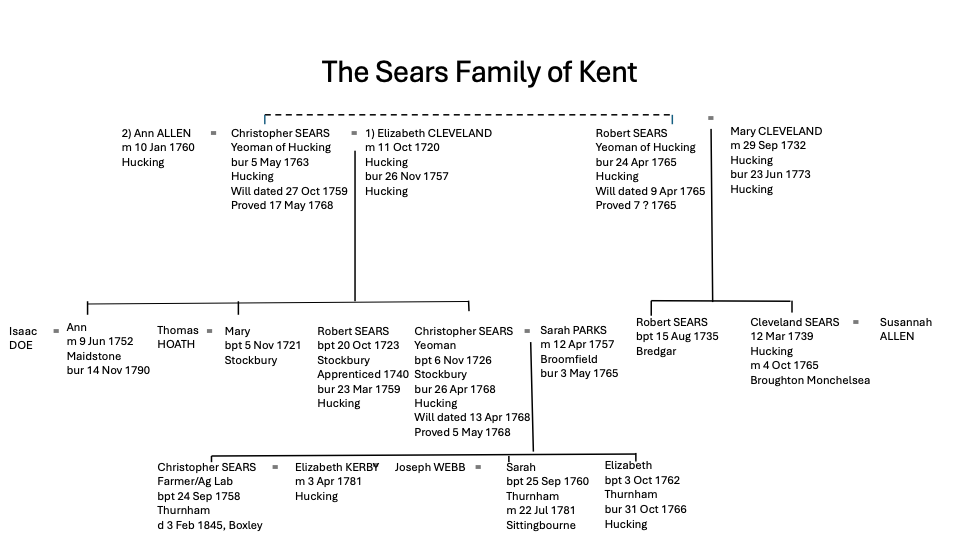
The wills were a great find, enabling me to distinguish between the Christopher Sears burials that appear in the registers of Hucking and identify which Christopher Sears had married Ann Allen. They also helped me locate significant entries. I only found the baptism of Sarah, the daughter of Christopher and Sarah Sears, after learning of her existence in her father’s will. A big problem that I encountered were the multiple spellings of Sears. Possible variants include Seare, Seares, Seers, Sares, Seires, Sarys, Siers, Sayres, Sayers, Scares, Seeres, Seres, Seyares, Sheares, Shires, and Skeeres. There were also some transcription errors on FindmyPast. I found that the long ‘S’ in Sears had been sometimes transcribed as Lear(s), which was not picked up by the search engines, even though I had ticked the variant search box. Similarly, I could not locate the burial of Robert Sears in 1765 initially. This was because his occupation of “Yeoman”, recorded in the burial entry, had been indexed as his surname.
As transcription errors can often be encountered, it is well worth browsing the original registers where possible. More detail on the Kent parish registers that are available on FindmyPast can be found here: https://search.findmypast.co.uk/search-world-images/kent-county-council-parish-register-browse? If you type in the name of the parish, you can discover what parish registers are available to view. I typed in Hucking and found that there are no parish registers to view on FindmyPast after 1725 until the new style registers of Rose’s Act came into force in 1813:
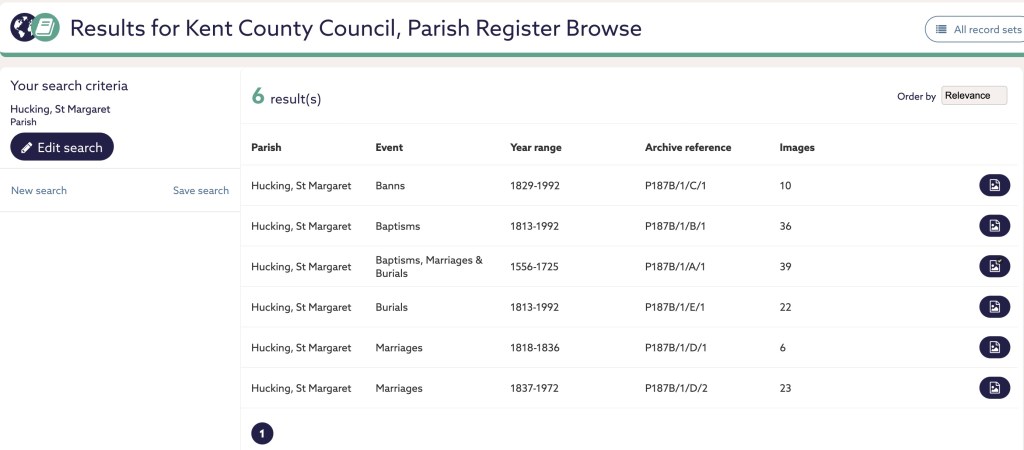
The lack of registers for Hucking post 1725 explained why I had not found the burial of Sarah Sears, the wife of Christopher Sears junior, on FindmyPast. Luckily, I found the transcribed burial entry on Ancestry, (though it originated from FamilySearch). Sarah Sears had been buried in Hucking on 3 May 1765. It was a reminder to look at as many different websites as possible when searching for parish register entries and to look at the original registers where possible.
When I looked at the original Hucking registers, I found they were badly kept between 1700 to 1725 so many entries are probably missing from this period. Bishops’ transcripts, if they are available, could help fill in the gaps. However, at earlier dates, the registers were well kept and the handwriting was legible. One advantage of browsing the original registers is that you soon become familiar with the families living in the parish at the time.

Church of St Margaret, Hucking, Kent
© Copyright Robin Webster and licensed for reuse under this Creative Commons Licence
Returning to poll books, I found an entry for Christopher Siers of Hucking in a Poll Book of 1752. He had freehold land and a house situated in Stockbury, which was occupied by Edward Williams:
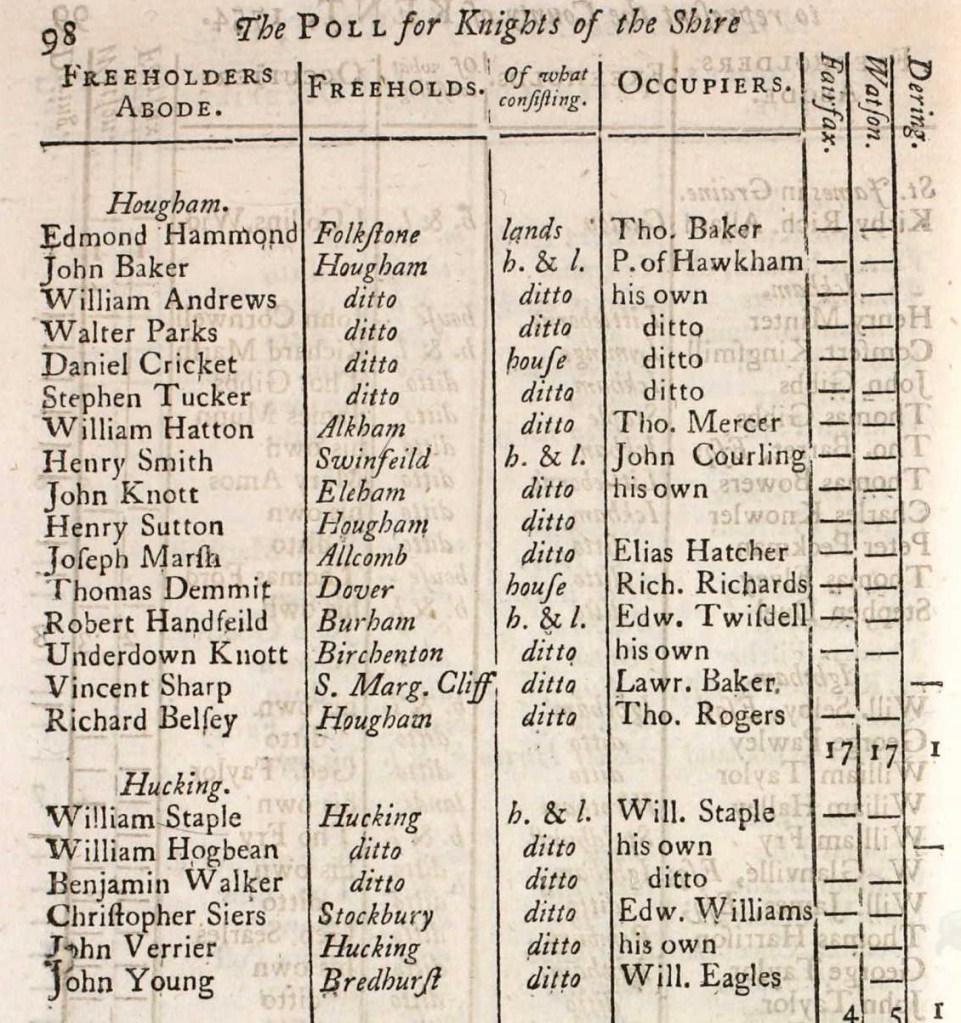
UK, Poll Books and Electoral Registers, 1538-1893 London Metropolitan Archives via https://www.ancestry.co.uk/
It’s probable that this entry refers to Christopher Sears senior, rather than his son who had yet to inherit from his father.
The earliest reference I have found to the Sears family is the marriage of Christopher Sears senior to Elizabeth Cleveland in Hucking in 1720. Robert Sears, who married Mary Cleveland in Hucking in 1732 was probably his brother but I cannot find baptisms for either of them. There are also several baptisms in Stockbury where the father is named as Robert Sears, a lone entry in 1722 and the rest between 1734 and 1743:
- 9 Dec 1722 Richard son of Robert and Elizabeth Seares Stockbury
- 19 Jan 1734 Robert son of Robert and Ann Sears Stockbury
- 21 Mar 1735 Ann, daughter of Robert and Ann Sears Stockbury
- 23 Apr 1738 Eliz. daughter of Robert and Ann Seers Stockbury
- 14 Aug 1743 Mary, daughter of Robert and Ann Sears Stockbury
The marriage of Robert Seares and his wife, Elizabeth, took place in Stockbury in 1721:
- Robert Seares married Elizabeth Fox/Fores 1 Oct 1721
Elizabeth may have been Robert’s first wife and Robert might have married Ann after her death. However, I cannot find a record of Robert and Ann’s marriage. Since Robert Sears and Ann were having children baptised in Stockbury at the same time as Robert Sears and Mary (Cleveland), there were evidently two individuals named Robert Sears living in Stockbury at the same time. They could well have been cousins.
When I visited Kent Archives, I consulted their parish catalogue to see what other parish records they have for Hucking and Stockbury. Unfortunately, it appears that there are no surviving parish records for Hucking prior to the 19th century but in Stockbury, there are some overseers’ accounts that began in 1731. I spent a happy hour viewing these but since they are unindexed, I got no further than 1739. I found a large number of references to a Robert Sears in the 1730s accounts and learnt quite a lot about him, (though I don’t know if he was the husband of Mary or Elizabeth). The Overseers’ Assessments record each ratepayer in turn, twice a year. Robert Sears paid a rate of 4 shillings based on his annual rent of £4 and he was recorded as living at the vicarage. He wasn’t the incumbent of Stockbury but Hasted’s “The History and Topographical Survey of the County of Kent” published in 1798 provided some clues:
The church and vicarage of Stockbury remained part of the possessions of the above-mentioned priory till the dissolution of it, in the reign of Henry VIII. when it came, with the rest of the revenue of that house, into the king’s hands.
After which, the king, by his donation-charter, in his 33d year, settled both the parsonage and advowson of the vicarage of the church of Stockbury on his newerected dean and chapter of Rochester, with whom they now remain.
On the abolition of deans and chapters, after the death of king Charles I. this parsonage was surveyed, by order of the state, in 1649, when it was returned, that the rectory or parsonage of Stockbury, late belonging to the dean and chapter of Rochester, consisted of a fair dwelling-house, dove house, and other necessary buildings, yards, &c. and the tithes belonging to it, all which were valued at eighty pounds per annum, and the glebe-lands, containing one hundred and forty-four acres, were worth, with the above, 132l. 10s. all which premises were let by the dean and chapter, anno 16 king Charles I. to John Hooper, for twenty-one years, at the yearly rent of 14l. 5s. 4d. That the lesse was bound to repair the chancel; and that the vicarage was excepted, worth fifty pounds per annum.
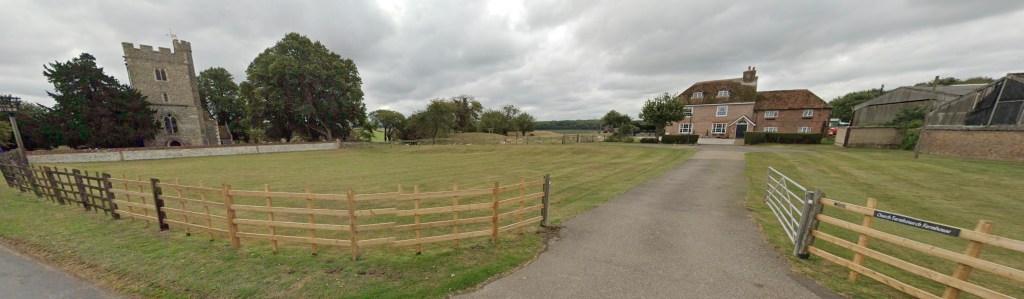
The presentation to the vicarage of this church is reserved by the dean and chapter, in their own hands. but the parsonage continued to be leased out to the family of Hooper, who resided there; several of whom lie buried in this church, particularly John, son of James Hooper, gent. of Halberton, in Devonshire, which John was receiver of the fines, under king Philip and queen Mary, for the Marches, of Wales, and died in 1548. He married Frances, daughter of Sir Thomas Roberts, of Glassenbury. At length, by marriage of one of the daughters of Walter Hooper, esq. it passed to William Hugessen, esq. eldest son of John Hugessen, esq. of Stodmarsh. He resided here till his father’s death, when he removed to Stodmarsh, and he is the present lessee of this parsonage, under the dean and chapter.
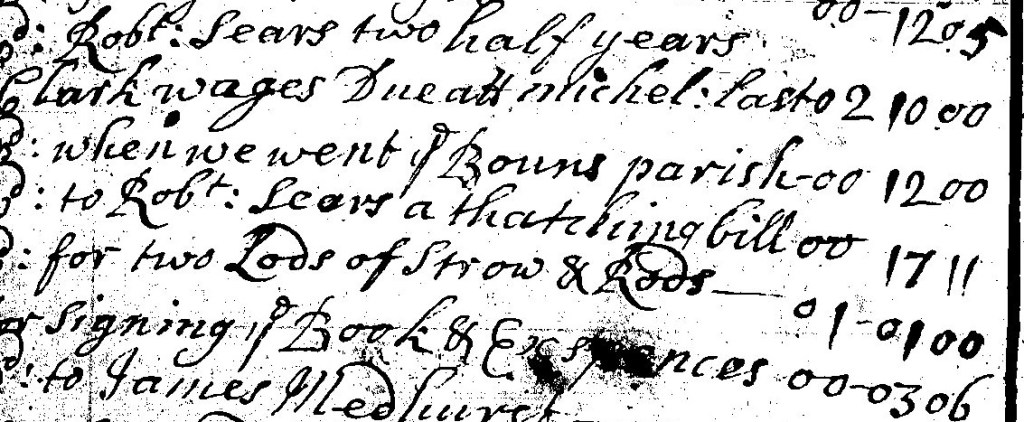
In the 1730s, Robert Sears was leasing the parsonage ( recorded as the vicarage in the accounts), next to the church. He was an educated man, as he also held the position of parish clerk. There were several entries recording his wages and expenses and numerous instances of his signature. He was also paid for thatching and on occasion, providing clothes or material. For example, he was paid for providing a coat and half an ell of cloth for Mary Beale in the assessment dated 28 April 1738 so perhaps he did some weaving as well. He also helped the parish officials with the Lullcock family that had fallen on hard times with the death of the father. When Goodman Lullcock was buried, he was at The Harrow (the pub in Stockbury), for Widdow Lullcock’s sale, and went to Milton to bind Edward Lullcock (for his apprenticeship), being paid for his expenses.
Here are several entries concerning his bills in an account dated 25 October 1734:
Christopher Sears also appeared in the accounts but usually just as a ratepayer. His assessment was higher than Robert, as he paid 6 shillings, based on his rent of £6. In the accounts, the ratepayers living in the centre of Stockbury were listed first, then those at Hill Green, Yelstead, Other Side of Church, and the Out Dwellers. Christopher Sears always featured in the Other Side of Church section. In the accounts dated 1 October 1731, he was paid 5 shillings 6 pence for water for the poor. This suggests that he lived in a lower lying area, perhaps around the hamlet of South Street today. He also features in a Poll Book for Kent in 1734, living in Stockbury, which was also the location of his freehold land. Clearly there had been a long tradition of voting in the family:
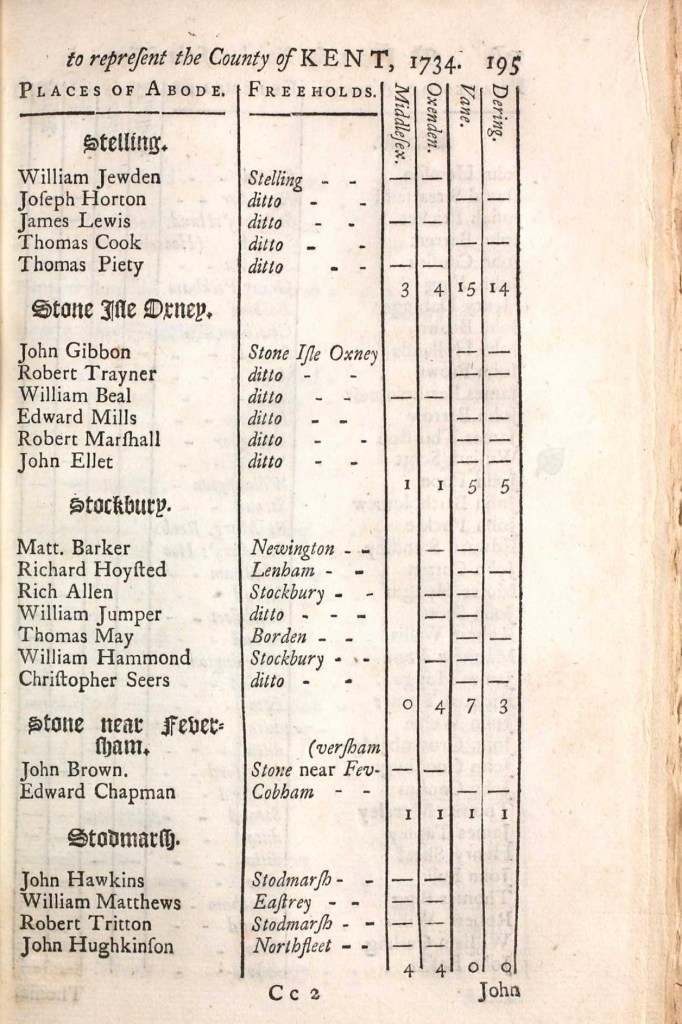
UK, Poll Books and Electoral Registers, 1538-1893 London Metropolitan Archives via https://www.ancestry.co.uk/
Although my ancestor, Christopher Sears (1756-1845), was described as an agricultural labourer on his death certificate, I have found that that he was descended from prosperous yeoman farmers in the Stockbury/Hucking area and represented the third generation of men named Christopher Sears. The newspaper advertisement that indicated that Christopher Sears had once leased land in Stockbury was the catalyst for my research. This led me to discover that earlier in his life, he had held freehold land in Bromfield, as evidenced by the 1790 Poll Book and 1798 Land Tax Redemption. Poll Books have shown that that both his father and grandfather were part of the small minority of men that were entitled to vote and were owners of freehold land. A particular highlight was the three Sears wills proved by the Archdeaconry of Rochester, which revealed a lot about family relationships in the 18th century.
I hope that I have shown how it is possible to find interesting information about an ordinary family in 18th century England. Although I haven’t as yet been able to identify the origins of Christopher and Robert Sears prior to 1720, it’s possible that additional evidence may be found through further study of wills from Stockbury and surrounding parishes. Similarly, given their land holdings, manorial court rolls, title deeds and estate papers, where they have survived, could contain further clues. What this space!
© Judith Batchelor 2024

 Genealogy Jude
Wow! Another tour de force, Judith. You put such energy into your research.
LikeLiked by 1 person
Thank you! It was a bit of a beast to put together! 😄
LikeLike
Very exciting to discover an ordinary family hiding in documents! Congratulations. Also thanks for showing the original documents and explaining your methodology. Good thing you took the time to look at each document, not just the index.
LikeLiked by 1 person
Thank you! It was great to keep finding mentions of them in the records over three generations. It did take some digging though to find them.
LikeLike
Yes, it was fun to discover that a labourer once owned and leased land, and was a voter. It was interesting too to use some sources that one doesn’t come across so often. A bit of extra checking of the original records can really pay off.
LikeLike
Very impressive, inspirational and well documented research Judith. Incredible to think that only the top 1% of population were eligible to vote in 1832 due to a requirement of needing to own land; fortuitous that your ancestors fell in that relatively high social stratum. It’s sobering to think that even come 1918 men, often returning from war, had to own land (approximately two in three men) to be able to vote.
LikeLiked by 1 person
Thank you for your kind comments. It is amazing that so few people could vote and when they did, it was all made public! Neither of my grandmothers could vote either when they turned 21. I would love to be able to ask them what they thought about the women’s suffrage movement.
LikeLike
A thorough and intriguing family narrative – I’m going to reread it after my vacation to glean more details. Thanks for the link to the Kent Archives probate index – I have found two wills, one of which might answer a very important question. Hoping I might find them in FamilySearch’s collection as I can’t get to Kent Archives, at least not this year.
I always enjoy reading your detailed posts – they’re a great example for those wanting to learn how to write a case study.
LikeLiked by 1 person
Thanks Teresa! One of the main aims of my blog is to provide some case studies of how to go about research, showing how evidence from one record leads to another. Initially, I asked Kent Archives for a quote to supply the probate records. It was a bit steep so I had fun looking at them myself. It’s a good thing that you have the option of seeing them at a FamilySearch Center.
LikeLiked by 1 person
Fingers crossed it works… I’ll know later next week. The index was also helpful in that I’d been looking for a will I thought SHOULD exist, but in fact, it seems it doesn’t. I just hope that of William Keel is detailed enough to give me the answers I need!
LikeLiked by 1 person
This is an excellent case study demonstrating how a single record (in this case a newspaper advertisement for a farm sale) can be the springboard to further research via many other sources. It’s easy to make assumptions about our labourer ancestors, that they descend from many generations of illiterate workers who merely subsisted, and who left barely a trace in the records, but you’ve shown very clearly that even ‘ordinary’ family history can be so much richer and interesting than expected. I particularly enjoyed reading about the family dramas that were apparent from the wills, including Christopher marrying a younger woman on his death bed, his son’s probable concealment of the will, and the instruction to Robert to pay his brother.
LikeLiked by 1 person
Thanks Clare, you have expressed perfectly what I set out to achieve. The wills did turn out to be ‘juicy’ and threw a spotlight on family relationships. I hadn’t come across a will before that mentioned an intended wife.
LikeLike
Hello Judith. My Gmail got derailed some months back and I didn’t get your post until months later. I enjoy reading your posts. Most of my research is concerned with last half of 17th and 18th centuries in North Carolina. Before that it is English. I’m a stop and go amateur genealogy person. Last name Batchelor same as yours (-: Jimmy Harold Batchelor
LikeLiked by 1 person
Nice to hear from you again Jimmy. Glad you got to read my post on my Kent ancestors. Best wishes from one Batchelor to another!
LikeLike